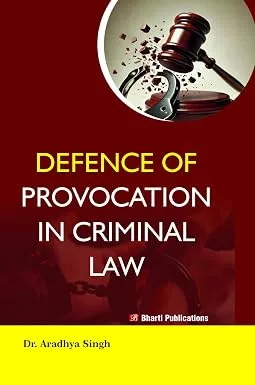
Defence of Provocation in Criminal Law
Hardcover
• 200 Pages
• inr 860.00
• English
• 9789347303258
No ratings yet
| Publisher | Bharti Publications |
|---|---|
| Brand/Group | Bharti Publications |
| ISBN13 | 9789347303258 |
| ASIN/SKU | 9347303259 |
| Book Format | Hardcover |
| Language | English |
| Pages | 200 |
| List Price | inr 860.00 |
| Dimensions | 14 x 1.7 x 21.5 |
| Weight | 350g |
| Book Code | BD00067236 |
Discover Defence of Provocation in Criminal Law by Dr. Aradhya Singh. This book is published by Bharti Publications in Hardcover format, ISBN 9789347303258, ASIN 9347303259, under Criminal Law, Law.
Book Description
Defence of Provocation in Criminal Law is a comprehensive and scholarly exploration of one of the most debated doctrines in criminal jurisprudence. Built on a blend of historical evolution, theoretical analysis, and judicial interpretation, the book offers a complete and contemporary understanding of how the defence of provocation functions within the Indian legal system and across global jurisdictions. Recognizing that provocation lies at the intersection of law, psychology, morality, and social norms, this work examines not only the doctrinal foundations but also the human realities behind cases involving loss of self-control. It traces the defence from its common law roots to modern reforms such as the “loss of control” test in England, while also providing rich comparative analysis from Canada, Australia, the United States, and Asian jurisdictions.
Author Biography
Dr. Aradhya Singh is an Assistant Professor at the School of Law, UPES, Dehradun. She earned her Ph.D. in Criminal Law from the Faculty of Law, Banaras Hindu University (BHU), awarded in December 2023, and qualified the UGC-NET in 2017. A Gold Medalist in her undergraduate studies, Dr. Singh’s academic and research interests span Criminal Law, Gender Studies, Special Exceptions in Criminal Law, Animal Law, and Environmental Law. Her scholarly work has been published in Scopus-indexed journals such as Jindal Global Law Review by Springer, AIP and several national and international university law journals.
Editorial Reviews
Editorial Reviews will be added soon…
Book Summary
Defence of Provocation in Criminal Law is a comprehensive and thought-provoking study of one of the most complex and controversial doctrines in criminal jurisprudence. The doctrine of provocation has long occupied a unique position in criminal law because it attempts to reconcile legal accountability with the realities of human emotions. It recognizes that individuals may, under extraordinary circumstances, lose self-control due to sudden and severe provocation, thereby affecting the degree of their criminal liability. This book provides an in-depth examination of the historical origins, theoretical foundations, judicial interpretations, and contemporary relevance of the defence of provocation within the Indian legal framework and in comparative international contexts.
The book begins by introducing readers to the conceptual basis of the defence of provocation. It explains how criminal law generally assumes that individuals possess the capacity to exercise self-control and make rational decisions. However, the law also acknowledges that extreme emotional circumstances may temporarily impair judgment and self-restraint. The doctrine of provocation emerged as a legal mechanism to address such situations by reducing what would otherwise constitute murder to culpable homicide under specific circumstances. The book carefully explores the legal philosophy behind this exception and demonstrates why it continues to generate debate among judges, legislators, scholars, and practitioners.
A significant portion of the work is devoted to tracing the historical development of the doctrine. Beginning with its origins in English common law, the book explains how the defence evolved over centuries through judicial decisions and legislative reforms. It examines early common law principles that recognized certain categories of provocation and gradually expanded the doctrine through judicial interpretation. The discussion highlights the changing attitudes of society toward anger, honour, revenge, and personal responsibility, illustrating how legal concepts have evolved alongside social and moral values.
The author provides a detailed analysis of the statutory framework governing the defence of provocation under Indian criminal law. Particular attention is given to the provisions of the Indian Penal Code and their interpretation by Indian courts. Through careful examination of landmark judicial decisions, the book explains the essential ingredients required to establish the defence, including grave and sudden provocation, loss of self-control, absence of premeditation, and the causal connection between the provocation and the resulting act. It further discusses the objective and subjective tests applied by courts while determining whether a reasonable person placed in similar circumstances would have reacted in a comparable manner.
An important contribution of this work lies in its extensive discussion of judicial interpretation. Rather than merely explaining statutory provisions, the author analyzes how courts have applied the doctrine in real-life cases involving family disputes, domestic violence, sudden quarrels, sexual jealousy, insults, and other emotionally charged situations. These case studies illustrate the challenges faced by judges in balancing legal principles with human psychology. The book demonstrates how seemingly similar factual situations may produce different legal outcomes depending upon the surrounding circumstances, judicial reasoning, and evolving legal standards.
Recognizing that criminal law cannot be understood in isolation from human behaviour, the book explores the interdisciplinary dimensions of provocation by integrating perspectives from psychology, behavioural science, sociology, and moral philosophy. It explains the psychological processes involved in emotional reactions, impulsive behaviour, stress, trauma, and loss of self-control. By examining the relationship between legal responsibility and psychological reality, the author offers readers a broader understanding of why the doctrine continues to remain relevant despite increasing criticism.
One of the distinguishing features of the book is its comprehensive comparative analysis of international legal systems. The author examines how different jurisdictions have approached the doctrine and how legal reforms have reshaped its application. Special emphasis is placed on the transformation of English law following the Coroners and Justice Act, 2009, which replaced the traditional defence of provocation with the doctrine of "loss of control." The book explains the rationale behind this reform, the criticisms of the earlier law, and the implications of the new legal framework for modern criminal jurisprudence.
The comparative discussion extends beyond England to include jurisdictions such as Canada, Australia, the United States, Singapore, Malaysia, and other common law countries. The author carefully compares statutory provisions, judicial approaches, evidentiary standards, and policy considerations across these legal systems. These comparisons enable readers to appreciate the similarities and differences in the treatment of provocation while highlighting the influence of cultural, social, and constitutional values on criminal law. Such international perspectives enrich the discussion and make the work valuable for comparative legal research.
The book also addresses several contemporary debates surrounding the defence of provocation. Critics have argued that the doctrine may inadvertently justify violent conduct, reinforce outdated notions of honour, or perpetuate gender bias. The author critically examines these concerns by evaluating feminist critiques, human rights perspectives, and modern theories of criminal responsibility. Issues relating to domestic violence, prolonged abuse, honour-based crimes, cultural defences, and gender-sensitive interpretations receive careful attention. The discussion encourages readers to consider whether the traditional doctrine adequately reflects present-day social realities or whether further reforms are necessary.
Another notable aspect of the work is its exploration of evidentiary and procedural issues associated with the defence. The book discusses the burden of proof, standards of evidence, admissibility of expert testimony, and the role of medical and psychological evidence in establishing loss of self-control. It explains how courts assess witness credibility, surrounding circumstances, and behavioural evidence while determining the applicability of the defence. These practical insights make the book particularly useful for judges, advocates, prosecutors, investigators, and law students seeking a deeper understanding of criminal trials involving provocation.
Throughout the book, the author adopts a balanced and analytical approach. Rather than advocating a particular position, the discussion presents competing viewpoints supported by judicial precedents, statutory provisions, academic scholarship, and comparative legal developments. This objective treatment enables readers to develop their own informed perspectives on the strengths and limitations of the doctrine. The clear organization of chapters, systematic presentation of legal principles, and extensive use of case law make complex legal concepts accessible without compromising scholarly depth.
The work further highlights the evolving relationship between criminal law and constitutional values. It considers how principles of fairness, proportionality, equality, and human dignity influence judicial interpretation of the defence. The author reflects on the challenges of maintaining consistency in judicial decisions while ensuring that the law remains responsive to changing social conditions. These discussions place the doctrine of provocation within the broader framework of modern criminal justice and legal reform.
In addition to its doctrinal and comparative analysis, the book serves as a valuable academic resource by encouraging critical thinking about the future of the defence. It raises important questions regarding the appropriate balance between legal accountability and human frailty, the role of emotions in criminal liability, and the need for harmonizing legal standards with contemporary scientific understanding of human behaviour. By engaging with these broader issues, the work contributes meaningfully to ongoing debates in criminal law scholarship.
The book begins by introducing readers to the conceptual basis of the defence of provocation. It explains how criminal law generally assumes that individuals possess the capacity to exercise self-control and make rational decisions. However, the law also acknowledges that extreme emotional circumstances may temporarily impair judgment and self-restraint. The doctrine of provocation emerged as a legal mechanism to address such situations by reducing what would otherwise constitute murder to culpable homicide under specific circumstances. The book carefully explores the legal philosophy behind this exception and demonstrates why it continues to generate debate among judges, legislators, scholars, and practitioners.
A significant portion of the work is devoted to tracing the historical development of the doctrine. Beginning with its origins in English common law, the book explains how the defence evolved over centuries through judicial decisions and legislative reforms. It examines early common law principles that recognized certain categories of provocation and gradually expanded the doctrine through judicial interpretation. The discussion highlights the changing attitudes of society toward anger, honour, revenge, and personal responsibility, illustrating how legal concepts have evolved alongside social and moral values.
The author provides a detailed analysis of the statutory framework governing the defence of provocation under Indian criminal law. Particular attention is given to the provisions of the Indian Penal Code and their interpretation by Indian courts. Through careful examination of landmark judicial decisions, the book explains the essential ingredients required to establish the defence, including grave and sudden provocation, loss of self-control, absence of premeditation, and the causal connection between the provocation and the resulting act. It further discusses the objective and subjective tests applied by courts while determining whether a reasonable person placed in similar circumstances would have reacted in a comparable manner.
An important contribution of this work lies in its extensive discussion of judicial interpretation. Rather than merely explaining statutory provisions, the author analyzes how courts have applied the doctrine in real-life cases involving family disputes, domestic violence, sudden quarrels, sexual jealousy, insults, and other emotionally charged situations. These case studies illustrate the challenges faced by judges in balancing legal principles with human psychology. The book demonstrates how seemingly similar factual situations may produce different legal outcomes depending upon the surrounding circumstances, judicial reasoning, and evolving legal standards.
Recognizing that criminal law cannot be understood in isolation from human behaviour, the book explores the interdisciplinary dimensions of provocation by integrating perspectives from psychology, behavioural science, sociology, and moral philosophy. It explains the psychological processes involved in emotional reactions, impulsive behaviour, stress, trauma, and loss of self-control. By examining the relationship between legal responsibility and psychological reality, the author offers readers a broader understanding of why the doctrine continues to remain relevant despite increasing criticism.
One of the distinguishing features of the book is its comprehensive comparative analysis of international legal systems. The author examines how different jurisdictions have approached the doctrine and how legal reforms have reshaped its application. Special emphasis is placed on the transformation of English law following the Coroners and Justice Act, 2009, which replaced the traditional defence of provocation with the doctrine of "loss of control." The book explains the rationale behind this reform, the criticisms of the earlier law, and the implications of the new legal framework for modern criminal jurisprudence.
The comparative discussion extends beyond England to include jurisdictions such as Canada, Australia, the United States, Singapore, Malaysia, and other common law countries. The author carefully compares statutory provisions, judicial approaches, evidentiary standards, and policy considerations across these legal systems. These comparisons enable readers to appreciate the similarities and differences in the treatment of provocation while highlighting the influence of cultural, social, and constitutional values on criminal law. Such international perspectives enrich the discussion and make the work valuable for comparative legal research.
The book also addresses several contemporary debates surrounding the defence of provocation. Critics have argued that the doctrine may inadvertently justify violent conduct, reinforce outdated notions of honour, or perpetuate gender bias. The author critically examines these concerns by evaluating feminist critiques, human rights perspectives, and modern theories of criminal responsibility. Issues relating to domestic violence, prolonged abuse, honour-based crimes, cultural defences, and gender-sensitive interpretations receive careful attention. The discussion encourages readers to consider whether the traditional doctrine adequately reflects present-day social realities or whether further reforms are necessary.
Another notable aspect of the work is its exploration of evidentiary and procedural issues associated with the defence. The book discusses the burden of proof, standards of evidence, admissibility of expert testimony, and the role of medical and psychological evidence in establishing loss of self-control. It explains how courts assess witness credibility, surrounding circumstances, and behavioural evidence while determining the applicability of the defence. These practical insights make the book particularly useful for judges, advocates, prosecutors, investigators, and law students seeking a deeper understanding of criminal trials involving provocation.
Throughout the book, the author adopts a balanced and analytical approach. Rather than advocating a particular position, the discussion presents competing viewpoints supported by judicial precedents, statutory provisions, academic scholarship, and comparative legal developments. This objective treatment enables readers to develop their own informed perspectives on the strengths and limitations of the doctrine. The clear organization of chapters, systematic presentation of legal principles, and extensive use of case law make complex legal concepts accessible without compromising scholarly depth.
The work further highlights the evolving relationship between criminal law and constitutional values. It considers how principles of fairness, proportionality, equality, and human dignity influence judicial interpretation of the defence. The author reflects on the challenges of maintaining consistency in judicial decisions while ensuring that the law remains responsive to changing social conditions. These discussions place the doctrine of provocation within the broader framework of modern criminal justice and legal reform.
In addition to its doctrinal and comparative analysis, the book serves as a valuable academic resource by encouraging critical thinking about the future of the defence. It raises important questions regarding the appropriate balance between legal accountability and human frailty, the role of emotions in criminal liability, and the need for harmonizing legal standards with contemporary scientific understanding of human behaviour. By engaging with these broader issues, the work contributes meaningfully to ongoing debates in criminal law scholarship.
Sample Chapters
Sample Chapters will be added soon…
Build Author or Publisher Website in Minutes
- Design a stunning professional website in minutes to showcase your portfolio, new releases, series, and bestselling titles.
- Use world-class cataloging software to create the metadata of your books. You will forget managing your metadata in excel.
- Share your large cover image and real-time metadata in with the publishing industry.
- Promote your books seamlessly across the Booksdata.org ecosystem and connect directly with a highly engaged reading community.