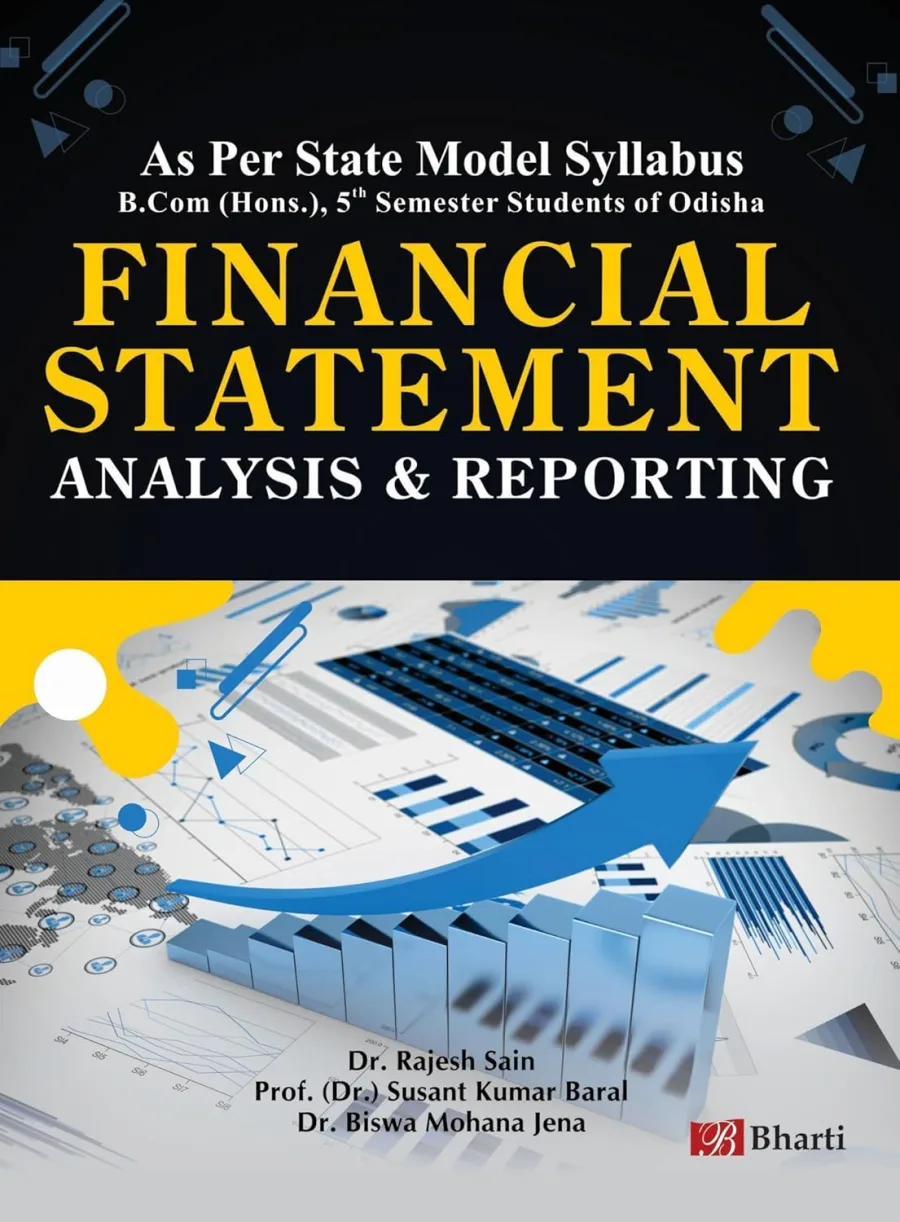
FINANCIAL STATEMENT ANALYSIS & REPORTING
Prof. (Dr.) Susant Kumar Baral, Dr. Biswa Mohana Jena
Paperback
• 216 Pages
• USD 275.00
• English
• 9789389657463
No ratings yet
| Publisher | Bharti Publications |
|---|---|
| Brand/Group | Bharti Publications |
| ISBN13 | 9789389657463 |
| ASIN/SKU | 9389657466 |
| Book Format | Paperback |
| Language | English |
| Pages | 216 |
| List Price | USD 275.00 |
| Dimensions | 18.25 x 2 x 23.75 |
| Weight | 275 |
| Book Code | BD00068309 |
Discover FINANCIAL STATEMENT ANALYSIS and REPORTING by Prof. (Dr.) Susant Kumar Baral. This book is published by Bharti Publications in Paperback format, ISBN 9789389657463, ASIN 9389657466, under Finance.
Book Description
Book covering income and balance sheet concepts for financial reporting, evaluation of Accounting Standards, objectives, role of reporting in economic development, double entry system, and stakeholders’ criteria for decision making. Pedagogical Features: Learning Objectives at the beginning of the chapters, Marginal Notes for a quick recap, Systematic discussion of the concepts endowed with illustrations and exhibits, Summary furnished at the end of the chapters to grasp the contents at the finger tips, Worked-out examples to develop the analytical and mathematical skills.
Author Biography
Author Biography will be added soon…
Editorial Reviews
Editorial Reviews will be added soon…
Book Summary
Financial Accounting is a comprehensive textbook that provides a strong foundation in the principles, concepts, and practices of financial accounting. Designed for undergraduate and postgraduate commerce and management students, the book offers a systematic understanding of accounting as a vital tool for financial reporting, business decision-making, and economic development. It combines theoretical knowledge with practical applications to help readers develop both conceptual clarity and analytical skills.
The book begins by introducing the fundamentals of accounting, including the objectives, scope, and importance of financial accounting in recording, classifying, and communicating financial information. It explains the **double-entry system of accounting**, enabling students to understand how business transactions are recorded accurately and how financial records are maintained in accordance with established accounting principles.
A major focus of the book is the preparation and interpretation of **financial statements**, particularly the **Income Statement** and **Balance Sheet**. Readers learn the concepts, structure, and significance of these statements in evaluating the financial performance and financial position of an organisation. The book also highlights the role of financial reporting in facilitating transparency, accountability, and informed decision-making for various stakeholders, including investors, creditors, management, regulators, and government agencies.
The text provides a detailed discussion of **Accounting Standards**, explaining their objectives, significance, and role in ensuring consistency, comparability, and reliability in financial reporting. It examines how accounting standards contribute to uniform reporting practices and strengthen confidence in financial information across businesses and industries.
Recognising the importance of accounting in the broader economy, the book explores the relationship between financial reporting and **economic development**, demonstrating how accurate and transparent financial information supports investment decisions, efficient allocation of resources, and sustainable business growth.
To enhance learning, the book incorporates several pedagogical features that make complex accounting concepts easier to understand. Each chapter begins with clearly defined **Learning Objectives**, followed by **Marginal Notes** that provide quick revision points. Concepts are explained systematically with the help of **illustrations, exhibits, and worked-out examples**, enabling students to strengthen their analytical and numerical problem-solving abilities. Every chapter concludes with a concise **Summary**, allowing readers to review key concepts quickly and prepare effectively for examinations.
Overall, *Financial Accounting* serves as an essential resource for students, educators, and aspiring accounting professionals. By combining comprehensive theoretical coverage with practical illustrations and student-friendly learning tools, the book equips readers with the knowledge and skills required to prepare, analyse, and interpret financial information in accordance with modern accounting practices.
The book begins by introducing the fundamentals of accounting, including the objectives, scope, and importance of financial accounting in recording, classifying, and communicating financial information. It explains the **double-entry system of accounting**, enabling students to understand how business transactions are recorded accurately and how financial records are maintained in accordance with established accounting principles.
A major focus of the book is the preparation and interpretation of **financial statements**, particularly the **Income Statement** and **Balance Sheet**. Readers learn the concepts, structure, and significance of these statements in evaluating the financial performance and financial position of an organisation. The book also highlights the role of financial reporting in facilitating transparency, accountability, and informed decision-making for various stakeholders, including investors, creditors, management, regulators, and government agencies.
The text provides a detailed discussion of **Accounting Standards**, explaining their objectives, significance, and role in ensuring consistency, comparability, and reliability in financial reporting. It examines how accounting standards contribute to uniform reporting practices and strengthen confidence in financial information across businesses and industries.
Recognising the importance of accounting in the broader economy, the book explores the relationship between financial reporting and **economic development**, demonstrating how accurate and transparent financial information supports investment decisions, efficient allocation of resources, and sustainable business growth.
To enhance learning, the book incorporates several pedagogical features that make complex accounting concepts easier to understand. Each chapter begins with clearly defined **Learning Objectives**, followed by **Marginal Notes** that provide quick revision points. Concepts are explained systematically with the help of **illustrations, exhibits, and worked-out examples**, enabling students to strengthen their analytical and numerical problem-solving abilities. Every chapter concludes with a concise **Summary**, allowing readers to review key concepts quickly and prepare effectively for examinations.
Overall, *Financial Accounting* serves as an essential resource for students, educators, and aspiring accounting professionals. By combining comprehensive theoretical coverage with practical illustrations and student-friendly learning tools, the book equips readers with the knowledge and skills required to prepare, analyse, and interpret financial information in accordance with modern accounting practices.
Sample Chapters
Sample Chapters will be added soon…
Build Author or Publisher Website in Minutes
- Design a stunning professional website in minutes to showcase your portfolio, new releases, series, and bestselling titles.
- Use world-class cataloging software to create the metadata of your books. You will forget managing your metadata in excel.
- Share your large cover image and real-time metadata in with the publishing industry.
- Promote your books seamlessly across the Booksdata.org ecosystem and connect directly with a highly engaged reading community.