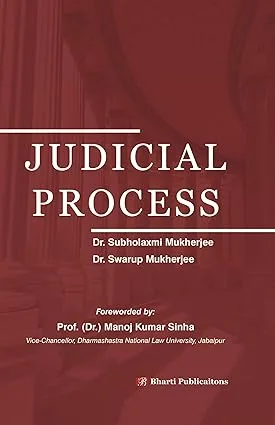
Judicial Process
Dr. Subholaxmi Mukherjee, Dr. Swarup Mukherjee
Paperback
• 328 Pages
• inr 495.00
• English
• 9789349566811
No ratings yet
| Publisher | Bharti Publications |
|---|---|
| Brand/Group | Bharti Publications |
| ISBN13 | 9789349566811 |
| ASIN/SKU | 9349566818 |
| Book Format | Paperback |
| Language | English |
| Pages | 328 |
| List Price | inr 495.00 |
| Publishing Date | 17/07/2025 |
| Dimensions | 15.65 x 2.5 x 23.75 |
| Weight | 425 |
| Book Code | BD00069459 |
Discover Judicial Process by Dr. Subholaxmi Mukherjee. This book is published by Bharti Publications in Paperback format, ISBN 9789349566811, ASIN 9349566818, under Law.
Book Description
The judicial Process stands as the cornerstone of constitutional democracy, embodying the rule of law, the protection of rights, and the advancement of justice in society. The book seeks to contextualize the judicial process within the larger framework of justice—drawing from Indian philosophical traditions such as Dharma, as well as Western jurisprudential theories including liberalism, utilitarianism, Marxism, and feminist critiques. These diverse perspectives illuminate the moral and ideological dimensions of adjudication, encouraging readers to critically evaluate the judiciary’s role in society. Intended for students of law, legal researchers, and practitioners, this textbook is both analytical and pedagogical. Each section is designed to provoke reflection, foster debate, and deepen understanding of the judiciary’s transformative potential and its limitations. By examining judicial accountability, activism, and structural reform.
Author Biography
Dr. Subholaxmi Mukherjee is a distinguished legal academician, presently serving as an Assistant Professor of Law at ICFAI University, Tripura. With over fourteen years of dedicated service in the field of legal education and research, she has emerged as a committed scholar and educator with a dynamic presence in the academic community. She has previously served as an Associate Professor at the prestigious Kolkata Police Law Institute and as an Assistant Professor at Durgapur Institute of Legal Studies. She is academically enriched with a First Class LL.M. degree (specialization in Business Law) from the University of Burdwan, where she stood third in the university, an LL.B. with First Class Fourth rank, and postgraduate and graduate degrees in History. Dr. Mukherjee holds a Ph.D. in Law from the University of Burdwan. Her teaching expertise lies in Constitutional Law, Human Rights, Jurisprudence, and Gender Justice, and she is known for using interactive, inclusive, and student-centric methodologies both in traditional and digital classrooms. Dr. Mukherjee is an avid researcher and prolific writer, with numerous publications in prestigious UGC CARE-listed and peer-reviewed journals.
Dr. Swarup Mukherjee is an accomplished legal academic and educator with over 14 years of experience in the field of law. He currently serves as an Associate Professor of Law at ICFAI University, Tripura, a position he has held since August 14, 2024. Prior to this, he held the esteemed position of Vice-Principal and Associate Professor at Durgapur Institute of Legal Studies. Dr. Mukherjee’s academic journey began with a Bachelor of Commerce from the University of Burdwan in 2004, followed by an LL.B. from the same institution in 2007. He completed his LL.M. with a specialization in Business Law from the University of Burdwan in 2010. He further pursued a Master of Commerce in 2012. He was awarded a Ph.D. from the University of Burdwan in 2022. Throughout his career, Dr. Mukherjee has demonstrated exemplary leadership and dedication to legal education. He has organized numerous interactive sessions with prominent legal and political figures, published extensively in UGC-approved journals, and participated in various national and international workshops, training programs, and seminars.
Dr. Swarup Mukherjee is an accomplished legal academic and educator with over 14 years of experience in the field of law. He currently serves as an Associate Professor of Law at ICFAI University, Tripura, a position he has held since August 14, 2024. Prior to this, he held the esteemed position of Vice-Principal and Associate Professor at Durgapur Institute of Legal Studies. Dr. Mukherjee’s academic journey began with a Bachelor of Commerce from the University of Burdwan in 2004, followed by an LL.B. from the same institution in 2007. He completed his LL.M. with a specialization in Business Law from the University of Burdwan in 2010. He further pursued a Master of Commerce in 2012. He was awarded a Ph.D. from the University of Burdwan in 2022. Throughout his career, Dr. Mukherjee has demonstrated exemplary leadership and dedication to legal education. He has organized numerous interactive sessions with prominent legal and political figures, published extensively in UGC-approved journals, and participated in various national and international workshops, training programs, and seminars.
Editorial Reviews
Editorial Reviews will be added soon…
Book Summary
The Judicial Process is a comprehensive and thought-provoking textbook that examines the role of the judiciary in upholding constitutional democracy, protecting individual rights, and advancing the ideals of justice. Designed for students of law, legal researchers, academicians, and practitioners, the book provides an analytical exploration of the judicial process by integrating constitutional principles, jurisprudential theories, and contemporary legal developments. It enables readers to understand not only how courts function but also the broader philosophical, ethical, and social dimensions of judicial decision-making.
The book begins by introducing the concept of the judicial process as the foundation of the rule of law and democratic governance. It explains the constitutional role of the judiciary in interpreting laws, safeguarding fundamental rights, resolving disputes, and maintaining the balance between the legislature, the executive, and the judiciary. Through a systematic and critical approach, readers gain a clear understanding of the judiciary's essential role in ensuring justice, accountability, and constitutional supremacy.
A distinctive feature of the book is its interdisciplinary treatment of justice. Rather than limiting the discussion to legal doctrines, it places the judicial process within the broader philosophical framework of justice by drawing upon both Indian and Western intellectual traditions. The text explores the concept of Dharma in Indian philosophy, highlighting its enduring relevance to justice, ethics, and social order. It also examines influential jurisprudential perspectives, including liberalism, utilitarianism, Marxism, and feminist legal theory, demonstrating how these schools of thought shape legal interpretation and judicial reasoning. By comparing diverse philosophical viewpoints, the book encourages readers to critically evaluate the moral, social, and ideological foundations of judicial decisions.
The book further analyses the functioning of courts and the principles that guide judicial interpretation. It discusses judicial reasoning, precedent, statutory interpretation, constitutional adjudication, and the evolving role of the judiciary in responding to complex social, political, and economic issues. Readers gain insight into how judges balance competing interests while preserving constitutional values and promoting justice in a rapidly changing society.
Special emphasis is placed on contemporary issues such as judicial accountability, judicial activism, judicial restraint, transparency, and institutional reforms. The book critically examines the expanding role of the judiciary in public governance while exploring the opportunities and challenges associated with judicial intervention in policy matters. It also discusses the need for structural reforms aimed at strengthening judicial independence, improving efficiency, and enhancing public confidence in the justice delivery system.
Written in a clear, systematic, and scholarly manner, the book combines theoretical analysis with practical relevance. Legal concepts are explained through logical discussions, judicial principles, and contextual examples that help readers appreciate both the strengths and limitations of the judicial system. Each chapter is designed to stimulate critical thinking, encourage academic debate, and deepen the reader's understanding of the judiciary's transformative role in constitutional governance.
Prepared primarily for undergraduate and postgraduate law students, the book is equally valuable for judicial service aspirants, legal researchers, faculty members, advocates, and policymakers. It serves as both a classroom textbook and a reliable reference for understanding the philosophy, functioning, and evolving role of the judiciary in modern democratic societies.
Overall, The Judicial Process provides a balanced and comprehensive examination of the theory and practice of judicial decision-making. By integrating constitutional law, jurisprudence, and contemporary legal challenges, the book equips readers with the analytical skills and critical perspective necessary to understand the judiciary's contribution to justice, constitutionalism, and the rule of law. It is an indispensable resource for anyone seeking a deeper understanding of the judicial process and its enduring significance in shaping a just and democratic society.
The book begins by introducing the concept of the judicial process as the foundation of the rule of law and democratic governance. It explains the constitutional role of the judiciary in interpreting laws, safeguarding fundamental rights, resolving disputes, and maintaining the balance between the legislature, the executive, and the judiciary. Through a systematic and critical approach, readers gain a clear understanding of the judiciary's essential role in ensuring justice, accountability, and constitutional supremacy.
A distinctive feature of the book is its interdisciplinary treatment of justice. Rather than limiting the discussion to legal doctrines, it places the judicial process within the broader philosophical framework of justice by drawing upon both Indian and Western intellectual traditions. The text explores the concept of Dharma in Indian philosophy, highlighting its enduring relevance to justice, ethics, and social order. It also examines influential jurisprudential perspectives, including liberalism, utilitarianism, Marxism, and feminist legal theory, demonstrating how these schools of thought shape legal interpretation and judicial reasoning. By comparing diverse philosophical viewpoints, the book encourages readers to critically evaluate the moral, social, and ideological foundations of judicial decisions.
The book further analyses the functioning of courts and the principles that guide judicial interpretation. It discusses judicial reasoning, precedent, statutory interpretation, constitutional adjudication, and the evolving role of the judiciary in responding to complex social, political, and economic issues. Readers gain insight into how judges balance competing interests while preserving constitutional values and promoting justice in a rapidly changing society.
Special emphasis is placed on contemporary issues such as judicial accountability, judicial activism, judicial restraint, transparency, and institutional reforms. The book critically examines the expanding role of the judiciary in public governance while exploring the opportunities and challenges associated with judicial intervention in policy matters. It also discusses the need for structural reforms aimed at strengthening judicial independence, improving efficiency, and enhancing public confidence in the justice delivery system.
Written in a clear, systematic, and scholarly manner, the book combines theoretical analysis with practical relevance. Legal concepts are explained through logical discussions, judicial principles, and contextual examples that help readers appreciate both the strengths and limitations of the judicial system. Each chapter is designed to stimulate critical thinking, encourage academic debate, and deepen the reader's understanding of the judiciary's transformative role in constitutional governance.
Prepared primarily for undergraduate and postgraduate law students, the book is equally valuable for judicial service aspirants, legal researchers, faculty members, advocates, and policymakers. It serves as both a classroom textbook and a reliable reference for understanding the philosophy, functioning, and evolving role of the judiciary in modern democratic societies.
Overall, The Judicial Process provides a balanced and comprehensive examination of the theory and practice of judicial decision-making. By integrating constitutional law, jurisprudence, and contemporary legal challenges, the book equips readers with the analytical skills and critical perspective necessary to understand the judiciary's contribution to justice, constitutionalism, and the rule of law. It is an indispensable resource for anyone seeking a deeper understanding of the judicial process and its enduring significance in shaping a just and democratic society.
Sample Chapters
Sample Chapters will be added soon…
Build Author or Publisher Website in Minutes
- Design a stunning professional website in minutes to showcase your portfolio, new releases, series, and bestselling titles.
- Use world-class cataloging software to create the metadata of your books. You will forget managing your metadata in excel.
- Share your large cover image and real-time metadata in with the publishing industry.
- Promote your books seamlessly across the Booksdata.org ecosystem and connect directly with a highly engaged reading community.