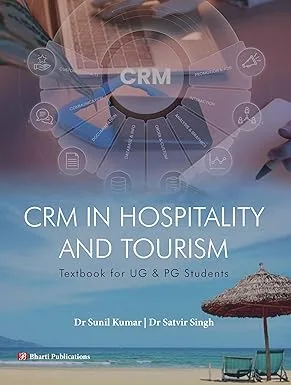
CRM in Hospitality and Tourism: Textbook for UG & PG Students
Dr. Satvir Singh, Dr. Sunil Kumar
Paperback
• 220 Pages
• inr 390.00
• English
• 978-9348059062
No ratings yet
| Publisher | Bharti Publications |
|---|---|
| Brand/Group | Bharti Publications |
| ISBN13 | 978-9348059062 |
| ASIN/SKU | 9348059068 |
| Book Format | Paperback |
| Language | English |
| Pages | 220 |
| List Price | inr 390.00 |
| Publishing Date | 08/11/2024 |
| Dimensions | 18 x 2 x 24 |
| Weight | 425 |
| Book Code | BD00069466 |
Discover CRM in Hospitality and Tourism: Textbook for UG and PG Students by Dr. Satvir Singh. This book is published by Bharti Publications in Paperback format, ISBN 978-9348059062, ASIN 9348059068.
Book Description
The hospitality and tourism industry, in particular, thrives on building and maintaining strong customer relationships. Given the industry’s reliance on customer satisfaction and loyalty, effective CRM practices can significantly enhance business performance and customer retention. This book delves into the unique challenges and opportunities that CRM presents in these sectors, providing readers with actionable insights and practical tools.
Author Biography
Author Biography will be added soon…
Editorial Reviews
Editorial Reviews will be added soon…
Book Summary
The hospitality and tourism industry is one of the world's fastest-growing and most dynamic sectors, where customer satisfaction, service quality, and long-term relationships play a crucial role in achieving sustainable success. In an increasingly competitive marketplace, organizations are no longer able to rely solely on the quality of their products or services. Instead, they must focus on understanding customer needs, delivering personalized experiences, and building lasting relationships. This book explores the principles, strategies, and applications of Customer Relationship Management (CRM) within the hospitality and tourism industry, offering a comprehensive guide for students, researchers, educators, and industry professionals.
Customer Relationship Management has evolved from being a simple customer database system to becoming a strategic business philosophy that integrates technology, marketing, customer service, and organizational culture. The book begins by introducing the fundamental concepts of CRM, explaining its evolution, objectives, and importance in today's service-oriented economy. Readers gain an understanding of how customer-centric approaches enable businesses to identify customer preferences, anticipate expectations, and create memorable experiences that foster customer loyalty and repeat business.
Special emphasis is placed on the distinctive characteristics of the hospitality and tourism industry, where customer interactions occur at every stage of the service journey—from planning and booking to travel, accommodation, dining, recreation, and post-service engagement. Unlike manufacturing industries, hospitality and tourism organizations deliver intangible experiences that depend heavily on employee performance and service quality. The book demonstrates how CRM serves as a bridge between businesses and customers by facilitating personalized communication, efficient service delivery, and long-term relationship building.
The text explores the various components of CRM, including customer acquisition, customer retention, customer satisfaction, customer loyalty, and customer lifetime value. It explains how organizations can collect, analyse, and utilize customer data to develop targeted marketing campaigns, personalized offers, and customized service experiences. Through detailed discussions, readers learn how customer information can be transformed into valuable business intelligence that supports strategic decision-making and competitive advantage.
Technology plays an increasingly significant role in modern CRM practices, and this book provides an in-depth examination of digital tools and platforms used across the hospitality and tourism sector. Topics such as Customer Relationship Management software, cloud-based CRM solutions, artificial intelligence, data analytics, mobile applications, social media integration, chatbots, and automation are discussed with practical relevance. The book highlights how technological innovations enable organizations to improve customer engagement, streamline operations, and provide seamless service experiences across multiple channels.
Recognizing the growing influence of digital transformation, the book also examines the impact of online booking platforms, travel portals, customer review websites, and social media on customer relationships. It explains how businesses can effectively manage online reputation, respond to customer feedback, monitor service quality, and build trust in the digital environment. Readers are introduced to strategies for managing customer interactions across various digital touchpoints while maintaining consistency and service excellence.
A dedicated section focuses on relationship marketing and its integration with CRM strategies. The book explains how trust, commitment, communication, and value creation contribute to long-term customer relationships. It explores loyalty programmes, membership schemes, personalized rewards, and customer engagement initiatives that encourage repeat visits and strengthen brand loyalty. Practical examples demonstrate how successful hospitality and tourism organizations have implemented relationship marketing strategies to enhance customer retention and profitability.
The role of employees in successful CRM implementation is thoroughly discussed throughout the book. Since hospitality and tourism are highly people-oriented industries, employee attitudes, communication skills, service quality, and organizational culture significantly influence customer satisfaction. The text emphasizes employee training, internal communication, leadership, and customer-oriented organizational practices that support effective relationship management. It highlights the importance of empowering employees to deliver exceptional service and resolve customer issues efficiently.
The book further examines customer service management, complaint handling, service recovery strategies, and conflict resolution techniques. It explains that customer complaints should not be viewed merely as problems but as valuable opportunities to improve service quality and strengthen customer trust. Readers gain practical knowledge about designing effective complaint management systems, responding to negative feedback professionally, and converting dissatisfied customers into loyal advocates through prompt and empathetic service recovery.
Marketing strategies tailored to hospitality and tourism businesses form another important component of the book. Readers are introduced to customer segmentation, target marketing, personalized promotions, digital marketing campaigns, email marketing, influencer marketing, and content marketing strategies that complement CRM initiatives. The book illustrates how integrated marketing communications can enhance customer engagement while maintaining consistent brand messaging across multiple platforms.
The importance of ethical practices, data privacy, and responsible customer information management is also addressed in detail. As organizations increasingly rely on customer data, the book discusses legal considerations, cybersecurity measures, and ethical responsibilities associated with data collection, storage, and utilization. It encourages organizations to maintain transparency, protect customer information, and build trust through responsible data governance.
Several chapters present practical case studies and industry examples from hotels, airlines, travel agencies, restaurants, resorts, cruise lines, and destination management organizations. These examples illustrate real-world CRM implementation, highlighting both successful practices and common challenges. Readers are encouraged to critically analyse organizational strategies and develop practical solutions applicable to diverse hospitality and tourism contexts.
The book also explores emerging trends shaping the future of CRM in hospitality and tourism. Topics such as artificial intelligence-driven personalization, predictive analytics, virtual reality tourism, smart hotels, Internet of Things (IoT), sustainability initiatives, and environmentally responsible customer engagement are discussed to prepare readers for the rapidly evolving business landscape. The integration of innovation with customer-centric management is presented as a key factor for maintaining competitiveness in the global tourism market.
Designed in accordance with contemporary academic and industry requirements, this book combines theoretical foundations with practical applications, making it suitable for undergraduate and postgraduate students, faculty members, researchers, hospitality professionals, tourism entrepreneurs, and management practitioners. Each chapter presents concepts in a clear and systematic manner, supported by examples, illustrations, review questions, and practical insights that facilitate effective learning and professional development.
Overall, Customer Relationship Management in Hospitality and Tourism serves as a comprehensive resource for understanding how organizations can create exceptional customer experiences while achieving long-term business success. By integrating strategic management principles, technological advancements, relationship marketing, and service excellence, the book equips readers with the knowledge and skills required to design and implement effective CRM strategies. It reinforces the idea that in the hospitality and tourism industry, strong customer relationships are not merely a competitive advantage but the foundation of sustainable growth, organizational excellence, and lasting customer loyalty.
Customer Relationship Management has evolved from being a simple customer database system to becoming a strategic business philosophy that integrates technology, marketing, customer service, and organizational culture. The book begins by introducing the fundamental concepts of CRM, explaining its evolution, objectives, and importance in today's service-oriented economy. Readers gain an understanding of how customer-centric approaches enable businesses to identify customer preferences, anticipate expectations, and create memorable experiences that foster customer loyalty and repeat business.
Special emphasis is placed on the distinctive characteristics of the hospitality and tourism industry, where customer interactions occur at every stage of the service journey—from planning and booking to travel, accommodation, dining, recreation, and post-service engagement. Unlike manufacturing industries, hospitality and tourism organizations deliver intangible experiences that depend heavily on employee performance and service quality. The book demonstrates how CRM serves as a bridge between businesses and customers by facilitating personalized communication, efficient service delivery, and long-term relationship building.
The text explores the various components of CRM, including customer acquisition, customer retention, customer satisfaction, customer loyalty, and customer lifetime value. It explains how organizations can collect, analyse, and utilize customer data to develop targeted marketing campaigns, personalized offers, and customized service experiences. Through detailed discussions, readers learn how customer information can be transformed into valuable business intelligence that supports strategic decision-making and competitive advantage.
Technology plays an increasingly significant role in modern CRM practices, and this book provides an in-depth examination of digital tools and platforms used across the hospitality and tourism sector. Topics such as Customer Relationship Management software, cloud-based CRM solutions, artificial intelligence, data analytics, mobile applications, social media integration, chatbots, and automation are discussed with practical relevance. The book highlights how technological innovations enable organizations to improve customer engagement, streamline operations, and provide seamless service experiences across multiple channels.
Recognizing the growing influence of digital transformation, the book also examines the impact of online booking platforms, travel portals, customer review websites, and social media on customer relationships. It explains how businesses can effectively manage online reputation, respond to customer feedback, monitor service quality, and build trust in the digital environment. Readers are introduced to strategies for managing customer interactions across various digital touchpoints while maintaining consistency and service excellence.
A dedicated section focuses on relationship marketing and its integration with CRM strategies. The book explains how trust, commitment, communication, and value creation contribute to long-term customer relationships. It explores loyalty programmes, membership schemes, personalized rewards, and customer engagement initiatives that encourage repeat visits and strengthen brand loyalty. Practical examples demonstrate how successful hospitality and tourism organizations have implemented relationship marketing strategies to enhance customer retention and profitability.
The role of employees in successful CRM implementation is thoroughly discussed throughout the book. Since hospitality and tourism are highly people-oriented industries, employee attitudes, communication skills, service quality, and organizational culture significantly influence customer satisfaction. The text emphasizes employee training, internal communication, leadership, and customer-oriented organizational practices that support effective relationship management. It highlights the importance of empowering employees to deliver exceptional service and resolve customer issues efficiently.
The book further examines customer service management, complaint handling, service recovery strategies, and conflict resolution techniques. It explains that customer complaints should not be viewed merely as problems but as valuable opportunities to improve service quality and strengthen customer trust. Readers gain practical knowledge about designing effective complaint management systems, responding to negative feedback professionally, and converting dissatisfied customers into loyal advocates through prompt and empathetic service recovery.
Marketing strategies tailored to hospitality and tourism businesses form another important component of the book. Readers are introduced to customer segmentation, target marketing, personalized promotions, digital marketing campaigns, email marketing, influencer marketing, and content marketing strategies that complement CRM initiatives. The book illustrates how integrated marketing communications can enhance customer engagement while maintaining consistent brand messaging across multiple platforms.
The importance of ethical practices, data privacy, and responsible customer information management is also addressed in detail. As organizations increasingly rely on customer data, the book discusses legal considerations, cybersecurity measures, and ethical responsibilities associated with data collection, storage, and utilization. It encourages organizations to maintain transparency, protect customer information, and build trust through responsible data governance.
Several chapters present practical case studies and industry examples from hotels, airlines, travel agencies, restaurants, resorts, cruise lines, and destination management organizations. These examples illustrate real-world CRM implementation, highlighting both successful practices and common challenges. Readers are encouraged to critically analyse organizational strategies and develop practical solutions applicable to diverse hospitality and tourism contexts.
The book also explores emerging trends shaping the future of CRM in hospitality and tourism. Topics such as artificial intelligence-driven personalization, predictive analytics, virtual reality tourism, smart hotels, Internet of Things (IoT), sustainability initiatives, and environmentally responsible customer engagement are discussed to prepare readers for the rapidly evolving business landscape. The integration of innovation with customer-centric management is presented as a key factor for maintaining competitiveness in the global tourism market.
Designed in accordance with contemporary academic and industry requirements, this book combines theoretical foundations with practical applications, making it suitable for undergraduate and postgraduate students, faculty members, researchers, hospitality professionals, tourism entrepreneurs, and management practitioners. Each chapter presents concepts in a clear and systematic manner, supported by examples, illustrations, review questions, and practical insights that facilitate effective learning and professional development.
Overall, Customer Relationship Management in Hospitality and Tourism serves as a comprehensive resource for understanding how organizations can create exceptional customer experiences while achieving long-term business success. By integrating strategic management principles, technological advancements, relationship marketing, and service excellence, the book equips readers with the knowledge and skills required to design and implement effective CRM strategies. It reinforces the idea that in the hospitality and tourism industry, strong customer relationships are not merely a competitive advantage but the foundation of sustainable growth, organizational excellence, and lasting customer loyalty.
Sample Chapters
Sample Chapters will be added soon…
Build Author or Publisher Website in Minutes
- Design a stunning professional website in minutes to showcase your portfolio, new releases, series, and bestselling titles.
- Use world-class cataloging software to create the metadata of your books. You will forget managing your metadata in excel.
- Share your large cover image and real-time metadata in with the publishing industry.
- Promote your books seamlessly across the Booksdata.org ecosystem and connect directly with a highly engaged reading community.