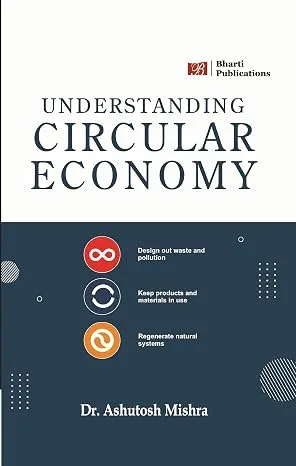
Understanding Circular Economy
Paperback
• 132 Pages
• inr 275.00
• English
• 9788119079414
No ratings yet
| Publisher | Bharti Publications |
|---|---|
| Brand/Group | Bharti Publications |
| ISBN13 | 9788119079414 |
| ASIN/SKU | 8119079418 |
| Book Format | Paperback |
| Language | English |
| Pages | 132 |
| List Price | inr 275.00 |
| Publishing Date | 29/06/2023 |
| Dimensions | 13.75 x 1.1 x 21.25 |
| Weight | 250 |
| Book Code | BD00069472 |
Discover Understanding Circular Economy by Dr. Ashutosh Mishra. This book is published by Bharti Publications in Paperback format, ISBN 9788119079414, ASIN 8119079418, under Economics.
Book Description
The book "Understanding Circular Economy”, provides a comprehensive overview of the concept and application of circular economy and its importance in achieving sustainability, making it an ideal resource for students, policymakers, and practitioners. The book is structured into five chapters, each of which delves into a critical aspect of the circular economy. Chapter one provides an overview of the linear economy and its limitations, highlighting the problems associated with the traditional "take-make-dispose" approach. Chapter two introduces the concept of circular economy as an alternative to the linear economy, explaining the principles of closed-loop systems, resource efficiency, and waste reduction. Chapter three focuses on Life Cycle Assessment (LCA) as a tool for evaluating the environmental impacts of products and services throughout their life cycle. The chapter discusses the importance of LCA in the transition towards a circular economy and explores its applications in different sectors. Chapter four explores Extended Producer Responsibility (EPR) as a critical policy tool in promoting sustainable resource management. The chapter mentions the legal and regulatory frameworks governing EPR and its role in incentivizing producers to design products that are easier to recycle and recover. Finally, chapter five explores the role of Industry 4.0 and organizational mindset in the transition towards a circular economy. The chapter examines the technological and organizational innovations necessary to create closed-loop systems and highlights the importance of collaboration and stakeholder engagement in achieving a sustainable future.
Author Biography
Dr. Ashutosh Mishra is an academician by profession with an illustrious academic career of 15+ years, at the prestigious Birla Institute of Technology, (Jharkhand, INDIA). Preceding this, he had a result-oriented stint in the corporate world for 5 Years, imparting him well-required corp
Editorial Reviews
Editorial Reviews will be added soon…
Book Summary
Understanding Circular Economy provides a comprehensive introduction to the principles, practices, and policy frameworks of the circular economy, emphasizing its significance in achieving sustainable development and responsible resource management. Designed for students, researchers, policymakers, and industry practitioners, the book explains how circular economy principles can address the environmental and economic challenges posed by the traditional linear model of production and consumption.
The book is organized into five chapters, each focusing on a key dimension of the circular economy. The opening chapter examines the conventional linear economy, characterized by the "take-make-dispose" model, and highlights its inherent limitations. It discusses the growing concerns of resource depletion, waste generation, environmental degradation, and climate change, demonstrating why the existing economic model is no longer sustainable. This chapter establishes the need for a transition towards a more regenerative and resource-efficient economic system.
The second chapter introduces the concept of the circular economy as a sustainable alternative to the linear model. It explains the core principles of designing out waste, extending product life cycles, promoting reuse, repair, remanufacturing, and recycling, while emphasizing resource efficiency and closed-loop systems. The chapter illustrates how circular economy practices can minimize environmental impacts, conserve natural resources, and generate economic opportunities by transforming waste into valuable resources.
The third chapter focuses on Life Cycle Assessment (LCA) as a scientific and analytical tool for evaluating the environmental impacts of products and services throughout their entire life cycle—from raw material extraction and manufacturing to use, disposal, and recycling. It discusses the methodologies, benefits, and practical applications of LCA across various industries, demonstrating how it supports informed decision-making and contributes to the effective implementation of circular economy strategies.
Chapter four examines Extended Producer Responsibility (EPR) as an essential policy instrument for sustainable resource management. The chapter explains the legal and regulatory frameworks governing EPR and explores how producer responsibility encourages environmentally responsible product design, efficient collection systems, recycling infrastructure, and waste recovery. It highlights the role of governments, industries, and consumers in creating effective EPR systems that reduce waste and promote circularity.
The final chapter explores the relationship between the circular economy, Industry 4.0, and organizational transformation. It discusses how advanced technologies such as the Internet of Things (IoT), Artificial Intelligence (AI), big data analytics, blockchain, automation, and digital manufacturing can facilitate resource optimization, improve supply chain transparency, and enable efficient closed-loop production systems. The chapter also emphasizes the importance of organizational culture, leadership, innovation, and stakeholder collaboration in successfully implementing circular economy practices.
Throughout the book, theoretical concepts are supported by practical examples and policy perspectives, making complex ideas accessible to readers from diverse academic and professional backgrounds. The discussion demonstrates that achieving a circular economy requires not only technological advancements but also supportive public policies, responsible business strategies, and active participation from consumers and communities.
Overall, Understanding Circular Economy serves as a valuable resource for understanding the transition from a linear to a circular economic model. By integrating environmental, economic, technological, and policy perspectives, the book provides readers with a holistic understanding of sustainable resource management and equips them with the knowledge needed to contribute to a more resilient, resource-efficient, and environmentally sustainable future.
The book is organized into five chapters, each focusing on a key dimension of the circular economy. The opening chapter examines the conventional linear economy, characterized by the "take-make-dispose" model, and highlights its inherent limitations. It discusses the growing concerns of resource depletion, waste generation, environmental degradation, and climate change, demonstrating why the existing economic model is no longer sustainable. This chapter establishes the need for a transition towards a more regenerative and resource-efficient economic system.
The second chapter introduces the concept of the circular economy as a sustainable alternative to the linear model. It explains the core principles of designing out waste, extending product life cycles, promoting reuse, repair, remanufacturing, and recycling, while emphasizing resource efficiency and closed-loop systems. The chapter illustrates how circular economy practices can minimize environmental impacts, conserve natural resources, and generate economic opportunities by transforming waste into valuable resources.
The third chapter focuses on Life Cycle Assessment (LCA) as a scientific and analytical tool for evaluating the environmental impacts of products and services throughout their entire life cycle—from raw material extraction and manufacturing to use, disposal, and recycling. It discusses the methodologies, benefits, and practical applications of LCA across various industries, demonstrating how it supports informed decision-making and contributes to the effective implementation of circular economy strategies.
Chapter four examines Extended Producer Responsibility (EPR) as an essential policy instrument for sustainable resource management. The chapter explains the legal and regulatory frameworks governing EPR and explores how producer responsibility encourages environmentally responsible product design, efficient collection systems, recycling infrastructure, and waste recovery. It highlights the role of governments, industries, and consumers in creating effective EPR systems that reduce waste and promote circularity.
The final chapter explores the relationship between the circular economy, Industry 4.0, and organizational transformation. It discusses how advanced technologies such as the Internet of Things (IoT), Artificial Intelligence (AI), big data analytics, blockchain, automation, and digital manufacturing can facilitate resource optimization, improve supply chain transparency, and enable efficient closed-loop production systems. The chapter also emphasizes the importance of organizational culture, leadership, innovation, and stakeholder collaboration in successfully implementing circular economy practices.
Throughout the book, theoretical concepts are supported by practical examples and policy perspectives, making complex ideas accessible to readers from diverse academic and professional backgrounds. The discussion demonstrates that achieving a circular economy requires not only technological advancements but also supportive public policies, responsible business strategies, and active participation from consumers and communities.
Overall, Understanding Circular Economy serves as a valuable resource for understanding the transition from a linear to a circular economic model. By integrating environmental, economic, technological, and policy perspectives, the book provides readers with a holistic understanding of sustainable resource management and equips them with the knowledge needed to contribute to a more resilient, resource-efficient, and environmentally sustainable future.
Sample Chapters
Sample Chapters will be added soon…
Build Author or Publisher Website in Minutes
- Design a stunning professional website in minutes to showcase your portfolio, new releases, series, and bestselling titles.
- Use world-class cataloging software to create the metadata of your books. You will forget managing your metadata in excel.
- Share your large cover image and real-time metadata in with the publishing industry.
- Promote your books seamlessly across the Booksdata.org ecosystem and connect directly with a highly engaged reading community.