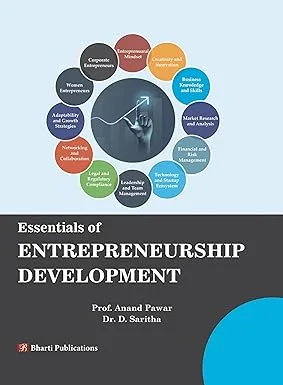
Essentials of Entrepreneurship Development
Prof. Anand Pawar, Dr. D. Saritha
Paperback
• 592 Pages
• inr 699.00
• English
• 9789349566644
No ratings yet
| Publisher | Bharti Publications |
|---|---|
| Brand/Group | Bharti Publications |
| ISBN13 | 9789349566644 |
| ASIN/SKU | 9349566648 |
| Book Format | Paperback |
| Language | English |
| Pages | 592 |
| List Price | inr 699.00 |
| Publishing Date | 22/04/2025 |
| Dimensions | 18 x 3 x 24 |
| Weight | 1010 |
| Book Code | BD00069475 |
Discover Essentials of Entrepreneurship Development by Prof. Anand Pawar. This book is published by Bharti Publications in Paperback format, ISBN 9789349566644, ASIN 9349566648, under Business.
Book Description
Essentials of Entrepreneurship Development is a comprehensive guide that delves into the fundamental and advanced aspects of entrepreneurship, aimed at equipping readers with the knowledge and skills required to succeed in the entrepreneurial landscape. Divided into five sections, the book covers a wide range of topics that are crucial for understanding and navigating the world of entrepreneurship including case studies.
Section A, Understanding Entrepreneurship, sets the foundation by defining what it means to be an entrepreneur and examining the different types of entrepreneurs, including rural entrepreneurs and agripreneurs. This section also explores the various factors that influence the growth and development of entrepreneurs, providing a deep understanding of the personal and external factors that shape entrepreneurial success.
In Section B, Business Organization and Finance, readers are introduced to the structural and financial aspects of entrepreneurship. It discusses the different forms of business organization, the role of Micro, Small, and Medium Enterprises (MSMEs) in fostering entrepreneurship, and the various sources of institutional and venture financing available to entrepreneurs.
Section C, Strategic Planning and Marketing emphasizes the importance of customer analysis, project evaluation, and the development of a detailed project report (DPR) in creating a successful business. It also covers effective marketing and sales strategies, which are essential for business growth and sustainability.
Section D, Leadership and Operations Management, focuses on the operational side of entrepreneurship, including leadership and team management skills, and how to efficiently manage operations and logistics within a business. Finally, Section E, Entrepreneurship Environment and Innovation addresses the entrepreneurial ecosystem in India, the role of innovation, and technology adoption including case studies.
This book serves as both a textbook and a practical guide for aspiring entrepreneurs, commerce, management and engineering students, and business professionals looking to enhance their entrepreneurial skills.
Section A, Understanding Entrepreneurship, sets the foundation by defining what it means to be an entrepreneur and examining the different types of entrepreneurs, including rural entrepreneurs and agripreneurs. This section also explores the various factors that influence the growth and development of entrepreneurs, providing a deep understanding of the personal and external factors that shape entrepreneurial success.
In Section B, Business Organization and Finance, readers are introduced to the structural and financial aspects of entrepreneurship. It discusses the different forms of business organization, the role of Micro, Small, and Medium Enterprises (MSMEs) in fostering entrepreneurship, and the various sources of institutional and venture financing available to entrepreneurs.
Section C, Strategic Planning and Marketing emphasizes the importance of customer analysis, project evaluation, and the development of a detailed project report (DPR) in creating a successful business. It also covers effective marketing and sales strategies, which are essential for business growth and sustainability.
Section D, Leadership and Operations Management, focuses on the operational side of entrepreneurship, including leadership and team management skills, and how to efficiently manage operations and logistics within a business. Finally, Section E, Entrepreneurship Environment and Innovation addresses the entrepreneurial ecosystem in India, the role of innovation, and technology adoption including case studies.
This book serves as both a textbook and a practical guide for aspiring entrepreneurs, commerce, management and engineering students, and business professionals looking to enhance their entrepreneurial skills.
Author Biography
Prof. Anand Pawar, a distinguished academician and administrator, currently serves as the Dean of the Faculty of Commerce & Business Management and the Director, Directorate of Materials and Publications at Dr. B.R. Ambedkar Open University, Hyderabad. Currently, he is also President of the Institution’s Innovation Council (IIC-AICTE) at BRAOU.
Dr. D. Saritha is a distinguished educator with 15 years of teaching experience, currently serving as an Assistant Professor of Commerce at the prestigious Government Degree & PG College for Women, Begumpet, Hyderabad.
Dr. D. Saritha is a distinguished educator with 15 years of teaching experience, currently serving as an Assistant Professor of Commerce at the prestigious Government Degree & PG College for Women, Begumpet, Hyderabad.
Editorial Reviews
Editorial Reviews will be added soon…
Book Summary
Essentials of Entrepreneurship Development is a comprehensive and contemporary textbook that provides an in-depth understanding of entrepreneurship as both a discipline and a practical pathway for economic and social transformation. Designed to meet the academic and professional needs of students, aspiring entrepreneurs, educators, and business practitioners, the book presents a balanced blend of theoretical concepts, practical frameworks, policy perspectives, and real-world case studies. It equips readers with the knowledge, skills, and entrepreneurial mindset required to identify opportunities, build sustainable enterprises, and successfully navigate the dynamic business environment.
The book is systematically organized into five comprehensive sections, each focusing on a critical dimension of entrepreneurship development. The logical progression of topics enables readers to develop a holistic understanding of entrepreneurial processes—from understanding the entrepreneurial mindset to establishing, managing, and growing a successful business.
Section A: Understanding Entrepreneurship introduces readers to the concept, meaning, and significance of entrepreneurship in today's global economy. It explores entrepreneurship as an engine of innovation, employment generation, and economic development. The section discusses the characteristics, qualities, and competencies of successful entrepreneurs while examining various categories of entrepreneurs, including women entrepreneurs, rural entrepreneurs, social entrepreneurs, agripreneurs, and technology-driven entrepreneurs. Special attention is given to the entrepreneurial ecosystem and the personal, social, economic, cultural, and institutional factors that influence entrepreneurial growth and success. By examining these dimensions, readers gain valuable insights into the qualities that distinguish successful entrepreneurs and the challenges they encounter throughout their entrepreneurial journey.
Section B: Business Organization and Finance focuses on the legal, organizational, and financial foundations of entrepreneurship. It provides a detailed overview of different forms of business organizations, enabling readers to understand the advantages, limitations, and suitability of each structure for different business ventures. The section highlights the significant role played by Micro, Small, and Medium Enterprises (MSMEs) in promoting innovation, employment, regional development, and economic resilience. It also explains the importance of entrepreneurship support institutions and government initiatives that facilitate enterprise development. Furthermore, readers are introduced to various sources of business finance, including institutional finance, commercial banks, government schemes, venture capital, angel investors, crowdfunding, and other emerging financing mechanisms. This section helps entrepreneurs understand how to mobilize financial resources and make informed investment decisions.
Section C: Strategic Planning and Marketing emphasizes the importance of systematic planning and customer-oriented business strategies. It guides readers through the process of identifying market opportunities, analysing customer needs, conducting market research, and evaluating the commercial viability of business ideas. The section provides practical knowledge on preparing a Detailed Project Report (DPR), an essential document for obtaining financial assistance and ensuring effective project implementation. It also discusses business planning, project appraisal, risk assessment, and resource allocation. Comprehensive coverage of marketing principles, branding, product positioning, pricing strategies, promotional techniques, digital marketing, and sales management equips readers with practical tools to compete effectively in today's rapidly changing markets. By integrating strategic planning with customer-centric marketing approaches, this section enables entrepreneurs to build sustainable and competitive enterprises.
Section D: Leadership and Operations Management examines the managerial competencies required to transform entrepreneurial ideas into successful organizations. Entrepreneurship extends beyond launching a business; it demands effective leadership, sound decision-making, efficient resource management, and continuous innovation. This section explores leadership styles, motivation, communication, team building, conflict management, and organizational behaviour. It also covers essential operational functions such as production planning, quality management, inventory control, supply chain coordination, logistics, and process optimization. Readers learn how effective leadership and operational excellence contribute to organizational efficiency, customer satisfaction, and long-term business sustainability.
Section E: Entrepreneurship Environment and Innovation focuses on the evolving entrepreneurial ecosystem and the increasing importance of innovation and technology in business success. It analyses India's entrepreneurial environment, highlighting government policies, institutional support systems, incubation centres, startup initiatives, and innovation-driven programmes designed to encourage entrepreneurship. The section explores the role of digital technologies, research and development, intellectual property, and technological innovation in creating competitive advantages. Through carefully selected case studies, readers gain practical insights into successful entrepreneurial ventures, innovative business models, and lessons learned from real-life entrepreneurial experiences. These examples bridge the gap between theory and practice while encouraging critical thinking and problem-solving skills.
One of the major strengths of this book is its learner-friendly approach. Complex entrepreneurial concepts are presented in a simple, clear, and systematic manner, making them accessible to readers from diverse academic backgrounds. Practical illustrations, examples, case studies, and contemporary business scenarios enhance conceptual understanding while encouraging the application of knowledge to real-world entrepreneurial challenges.
The book is particularly valuable for undergraduate and postgraduate students of commerce, management, economics, engineering, and vocational studies. It also serves as an essential resource for startup founders, aspiring entrepreneurs, business consultants, trainers, policymakers, and professionals seeking to strengthen their entrepreneurial competencies. By integrating academic knowledge with practical insights, the book supports skill development, innovation, opportunity recognition, strategic thinking, and effective decision-making.
Overall, Essentials of Entrepreneurship Development serves as both a comprehensive academic textbook and a practical handbook for entrepreneurship education. It provides readers with the conceptual foundations, strategic tools, managerial competencies, and innovative perspectives necessary to establish and sustain successful business ventures in an increasingly competitive and technology-driven world. By fostering entrepreneurial thinking, leadership, creativity, and resilience, the book empowers readers to transform ideas into opportunities, create value for society, and contribute meaningfully to economic growth and sustainable development.
The book is systematically organized into five comprehensive sections, each focusing on a critical dimension of entrepreneurship development. The logical progression of topics enables readers to develop a holistic understanding of entrepreneurial processes—from understanding the entrepreneurial mindset to establishing, managing, and growing a successful business.
Section A: Understanding Entrepreneurship introduces readers to the concept, meaning, and significance of entrepreneurship in today's global economy. It explores entrepreneurship as an engine of innovation, employment generation, and economic development. The section discusses the characteristics, qualities, and competencies of successful entrepreneurs while examining various categories of entrepreneurs, including women entrepreneurs, rural entrepreneurs, social entrepreneurs, agripreneurs, and technology-driven entrepreneurs. Special attention is given to the entrepreneurial ecosystem and the personal, social, economic, cultural, and institutional factors that influence entrepreneurial growth and success. By examining these dimensions, readers gain valuable insights into the qualities that distinguish successful entrepreneurs and the challenges they encounter throughout their entrepreneurial journey.
Section B: Business Organization and Finance focuses on the legal, organizational, and financial foundations of entrepreneurship. It provides a detailed overview of different forms of business organizations, enabling readers to understand the advantages, limitations, and suitability of each structure for different business ventures. The section highlights the significant role played by Micro, Small, and Medium Enterprises (MSMEs) in promoting innovation, employment, regional development, and economic resilience. It also explains the importance of entrepreneurship support institutions and government initiatives that facilitate enterprise development. Furthermore, readers are introduced to various sources of business finance, including institutional finance, commercial banks, government schemes, venture capital, angel investors, crowdfunding, and other emerging financing mechanisms. This section helps entrepreneurs understand how to mobilize financial resources and make informed investment decisions.
Section C: Strategic Planning and Marketing emphasizes the importance of systematic planning and customer-oriented business strategies. It guides readers through the process of identifying market opportunities, analysing customer needs, conducting market research, and evaluating the commercial viability of business ideas. The section provides practical knowledge on preparing a Detailed Project Report (DPR), an essential document for obtaining financial assistance and ensuring effective project implementation. It also discusses business planning, project appraisal, risk assessment, and resource allocation. Comprehensive coverage of marketing principles, branding, product positioning, pricing strategies, promotional techniques, digital marketing, and sales management equips readers with practical tools to compete effectively in today's rapidly changing markets. By integrating strategic planning with customer-centric marketing approaches, this section enables entrepreneurs to build sustainable and competitive enterprises.
Section D: Leadership and Operations Management examines the managerial competencies required to transform entrepreneurial ideas into successful organizations. Entrepreneurship extends beyond launching a business; it demands effective leadership, sound decision-making, efficient resource management, and continuous innovation. This section explores leadership styles, motivation, communication, team building, conflict management, and organizational behaviour. It also covers essential operational functions such as production planning, quality management, inventory control, supply chain coordination, logistics, and process optimization. Readers learn how effective leadership and operational excellence contribute to organizational efficiency, customer satisfaction, and long-term business sustainability.
Section E: Entrepreneurship Environment and Innovation focuses on the evolving entrepreneurial ecosystem and the increasing importance of innovation and technology in business success. It analyses India's entrepreneurial environment, highlighting government policies, institutional support systems, incubation centres, startup initiatives, and innovation-driven programmes designed to encourage entrepreneurship. The section explores the role of digital technologies, research and development, intellectual property, and technological innovation in creating competitive advantages. Through carefully selected case studies, readers gain practical insights into successful entrepreneurial ventures, innovative business models, and lessons learned from real-life entrepreneurial experiences. These examples bridge the gap between theory and practice while encouraging critical thinking and problem-solving skills.
One of the major strengths of this book is its learner-friendly approach. Complex entrepreneurial concepts are presented in a simple, clear, and systematic manner, making them accessible to readers from diverse academic backgrounds. Practical illustrations, examples, case studies, and contemporary business scenarios enhance conceptual understanding while encouraging the application of knowledge to real-world entrepreneurial challenges.
The book is particularly valuable for undergraduate and postgraduate students of commerce, management, economics, engineering, and vocational studies. It also serves as an essential resource for startup founders, aspiring entrepreneurs, business consultants, trainers, policymakers, and professionals seeking to strengthen their entrepreneurial competencies. By integrating academic knowledge with practical insights, the book supports skill development, innovation, opportunity recognition, strategic thinking, and effective decision-making.
Overall, Essentials of Entrepreneurship Development serves as both a comprehensive academic textbook and a practical handbook for entrepreneurship education. It provides readers with the conceptual foundations, strategic tools, managerial competencies, and innovative perspectives necessary to establish and sustain successful business ventures in an increasingly competitive and technology-driven world. By fostering entrepreneurial thinking, leadership, creativity, and resilience, the book empowers readers to transform ideas into opportunities, create value for society, and contribute meaningfully to economic growth and sustainable development.
Sample Chapters
Sample Chapters will be added soon…
Build Author or Publisher Website in Minutes
- Design a stunning professional website in minutes to showcase your portfolio, new releases, series, and bestselling titles.
- Use world-class cataloging software to create the metadata of your books. You will forget managing your metadata in excel.
- Share your large cover image and real-time metadata in with the publishing industry.
- Promote your books seamlessly across the Booksdata.org ecosystem and connect directly with a highly engaged reading community.