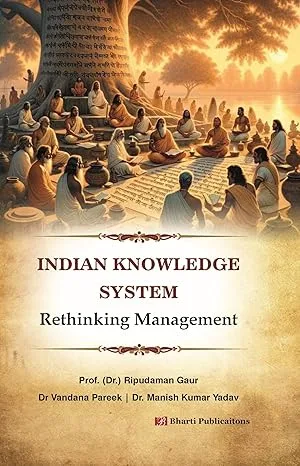
Indian Knowledge System: Rethinking Management
Prof. (Dr.) Ripudaman Gaur, Dr. Vandana Pareek
Paperback
• 208 Pages
• inr 495.00
• English
• 978934956610
No ratings yet
| Publisher | Bharti Publications |
|---|---|
| Brand/Group | Bharti Publications |
| ISBN13 | 978934956610 |
| ASIN/SKU | 9349566109 |
| Book Format | Paperback |
| Language | English |
| Pages | 208 |
| List Price | inr 495.00 |
| Publishing Date | 29/05/2025 |
| Dimensions | 15.75 x 2 x 23.75 |
| Weight | 300g |
| Book Code | BD00069478 |
Discover Indian Knowledge System: Rethinking Management by Prof. (Dr.) Ripudaman Gaur. This book is published by Bharti Publications in Paperback format, ISBN 978934956610, ASIN 9349566109, under Indian History.
Book Description
This book synthesizes traditional Indian wisdom, drawn from esteemed texts like the Bhagavad Gita, Ramcharitmanas, and Chanakya’s teachings, with both foundational and contemporary management principles. It seeks to provide students, scholars, and practitioners with profound insights into how age-old Indian frameworks can effectively inform leadership, strategic planning, ethical governance, team dynamics, and personal excellence. At its core, the book explores Dharma and Karma as pragmatic principles shaping decision-making and responsible, purpose-driven leadership. This book aims to ignite reflection and dialogue, presenting management as a philosophy rooted in values and consciousness. This book, Navigating Management Wisdom: Insights from Indian Knowledge Systems, aspires to serve as both a tribute and a critical exploration of the enduring principles found within Indian thought.
Author Biography
Dr. Ripudaman Gaur is a renowned Academician, Administrator, and Motivational Speaker, currently serving as Professor & Dean at Lloyd Business School, Greater Noida. With over 22 years of experience, he is known for his impactful work in academics, leadership, and brand building. A passionate proponent ofIndian Knowledge Systems (IKS), Dr. Gaur integrates ancient wisdom with modern education to inspire transformative learning. He has delivered 200+ sessions across India and abroad, and is a popular Quiz Master, having hosted 50+ national-level shows. Often called the “Brand Guru” and “Selfie Guru,” his sessions are known for their energy, insight, and creativity. Dr. Gaur has authored three books, holds multiple patents, and contributes actively to academic boards. Recipient of the “Best Motivational Educator” award, he continues to empower students and professionals to realize their full potential.
Dr. Vandana Pareek is a professor of Marketing Management with over 17 years of teaching and research experience. She holds a Ph.D. in Management and an MBA from Banaras Hindu University, and she has also qualified NET (JRF) in Management. Dr. Pareek has published several research papers in reputable journals, including Scopus, Web of Science, UGC CARE, and other peer-reviewed publications. Additionally, she has written books and book chapters, presented numerous papers at conferences, and chaired sessions. She has served on the syllabus restructuring committee established by AKTU and has acted as the Coordinator of the Research Degree Committee (RDC) in Management at AKTU.
Dr. Manish Kumar Yadav has obtained Ph.D. in Management from the Institute of Management Studies, Banaras Hindu University, Varanasi, India. Presently, he works as an Assistant Professor in the MBA (F & AB), Department of Agricultural Economics, I.Ag. Sc., B.H.U., Main Campus, Varanasi. He has qualified NET many times. He holds an MBA (Marketing and HR) from Uttar Pradesh Technical University, Lucknow. He has more than nine years of teaching and research experience. Dr. Yadav has several research papers and articles published in reputed journals, and also one book to his credit
Dr. Vandana Pareek is a professor of Marketing Management with over 17 years of teaching and research experience. She holds a Ph.D. in Management and an MBA from Banaras Hindu University, and she has also qualified NET (JRF) in Management. Dr. Pareek has published several research papers in reputable journals, including Scopus, Web of Science, UGC CARE, and other peer-reviewed publications. Additionally, she has written books and book chapters, presented numerous papers at conferences, and chaired sessions. She has served on the syllabus restructuring committee established by AKTU and has acted as the Coordinator of the Research Degree Committee (RDC) in Management at AKTU.
Dr. Manish Kumar Yadav has obtained Ph.D. in Management from the Institute of Management Studies, Banaras Hindu University, Varanasi, India. Presently, he works as an Assistant Professor in the MBA (F & AB), Department of Agricultural Economics, I.Ag. Sc., B.H.U., Main Campus, Varanasi. He has qualified NET many times. He holds an MBA (Marketing and HR) from Uttar Pradesh Technical University, Lucknow. He has more than nine years of teaching and research experience. Dr. Yadav has several research papers and articles published in reputed journals, and also one book to his credit
Editorial Reviews
Editorial Reviews will be added soon…
Book Summary
Navigating Management Wisdom: Insights from Indian Knowledge Systems presents a thoughtful and interdisciplinary exploration of management through the lens of India's rich intellectual and philosophical heritage. In an era characterized by rapid technological advancement, organizational complexity, and evolving leadership challenges, the book offers an alternative perspective that integrates timeless Indian wisdom with contemporary management thought. It demonstrates that effective management extends beyond technical competence and organizational efficiency, encompassing ethical conduct, self-awareness, social responsibility, and the pursuit of collective well-being.
Drawing inspiration from classical Indian knowledge traditions, the book synthesizes profound teachings from revered texts such as the Bhagavad Gita, Ramcharitmanas, Chanakya's Arthashastra, the Upanishads, and other foundational sources. These texts, while rooted in ancient philosophy, continue to offer enduring insights into leadership, governance, strategic thinking, decision-making, human behaviour, and organizational excellence. By interpreting these principles within the context of modern management, the book illustrates their continued relevance in addressing the complexities of contemporary institutions and professional life.
At the heart of this work lies the belief that management is not merely a collection of techniques or administrative functions but a holistic philosophy that harmonizes individual purpose with organizational goals and societal welfare. The book emphasizes that sustainable leadership is founded upon integrity, wisdom, compassion, accountability, and the ability to make balanced decisions even under conditions of uncertainty. Rather than focusing solely on maximizing profits or operational efficiency, it encourages readers to cultivate value-based leadership capable of creating long-term organizational and social impact.
A central theme explored throughout the book is the application of the principles of Dharma and Karma in management practice. These concepts are presented not simply as spiritual ideals but as practical frameworks for ethical decision-making, responsible leadership, and professional conduct. Dharma is examined as a guiding principle that enables individuals to fulfil their responsibilities with fairness, integrity, and commitment, while Karma is interpreted as emphasizing accountability, purposeful action, and the long-term consequences of managerial decisions. Together, these principles provide a robust ethical foundation for navigating complex organizational environments and balancing competing stakeholder interests.
The book further examines leadership through the perspectives offered by Indian philosophical traditions, presenting leaders as facilitators, mentors, and custodians of collective progress rather than merely authority figures. Drawing from the teachings of Lord Krishna, Lord Rama, and Chanakya, it explores qualities such as emotional intelligence, resilience, strategic foresight, humility, courage, and servant leadership. These perspectives demonstrate that true leadership requires inner discipline, clarity of purpose, and the ability to inspire trust and collaboration among diverse teams.
Strategic management forms another significant dimension of the book. Ancient Indian texts reveal sophisticated approaches to governance, diplomacy, planning, risk management, and conflict resolution that remain remarkably applicable in today's dynamic business environment. Through an examination of Chanakya's strategic insights and other classical frameworks, readers gain an appreciation of long-term planning, resource optimization, stakeholder management, and adaptive decision-making. These principles illustrate that sustainable organizational success depends upon foresight, ethical governance, and continuous learning rather than short-term gains.
The book also explores the importance of organizational culture, teamwork, communication, and human relationships from an Indian knowledge perspective. It emphasizes cooperation over competition, collective achievement over individual recognition, and harmony over conflict. Readers are encouraged to understand organizations as communities where mutual respect, empathy, trust, and shared values foster innovation, productivity, and employee well-being. Such an approach aligns closely with contemporary discussions on inclusive leadership, organizational resilience, and responsible management.
Another distinguishing feature of this work is its integration of traditional wisdom with emerging management challenges in the twenty-first century. Topics such as globalization, digital transformation, sustainability, corporate governance, innovation, and social responsibility are examined alongside classical philosophical principles. This interdisciplinary approach demonstrates that ancient Indian knowledge systems continue to provide meaningful guidance for addressing modern organizational issues while encouraging ethical innovation and socially responsible decision-making.
Written in a clear, engaging, and scholarly style, the book successfully bridges the gap between philosophy and practical management. Complex ideas are presented in an accessible manner, supported by conceptual discussions, contextual interpretations, and practical reflections that encourage readers to apply timeless principles in contemporary organizational settings. Rather than treating Indian knowledge systems as historical artefacts, the book positions them as dynamic sources of managerial insight capable of enriching current theories and practices.
The book serves as an invaluable resource for students of management, commerce, public administration, leadership studies, and organizational behaviour. It is equally relevant for academicians, researchers, policymakers, corporate executives, entrepreneurs, and professionals seeking a deeper understanding of value-based leadership and ethical management. By combining academic rigour with practical relevance, it contributes meaningfully to the growing discourse on indigenous management knowledge and culturally rooted leadership models.
Ultimately, Navigating Management Wisdom: Insights from Indian Knowledge Systems is both a tribute to India's enduring intellectual heritage and a critical exploration of its relevance in the modern world. It invites readers to rethink conventional approaches to management by embracing principles that integrate knowledge with wisdom, authority with responsibility, and success with service. Through this synthesis of ancient philosophy and contemporary management, the book inspires a more humane, ethical, and sustainable vision of leadership—one that nurtures individual excellence, organizational effectiveness, and the broader welfare of society.
Drawing inspiration from classical Indian knowledge traditions, the book synthesizes profound teachings from revered texts such as the Bhagavad Gita, Ramcharitmanas, Chanakya's Arthashastra, the Upanishads, and other foundational sources. These texts, while rooted in ancient philosophy, continue to offer enduring insights into leadership, governance, strategic thinking, decision-making, human behaviour, and organizational excellence. By interpreting these principles within the context of modern management, the book illustrates their continued relevance in addressing the complexities of contemporary institutions and professional life.
At the heart of this work lies the belief that management is not merely a collection of techniques or administrative functions but a holistic philosophy that harmonizes individual purpose with organizational goals and societal welfare. The book emphasizes that sustainable leadership is founded upon integrity, wisdom, compassion, accountability, and the ability to make balanced decisions even under conditions of uncertainty. Rather than focusing solely on maximizing profits or operational efficiency, it encourages readers to cultivate value-based leadership capable of creating long-term organizational and social impact.
A central theme explored throughout the book is the application of the principles of Dharma and Karma in management practice. These concepts are presented not simply as spiritual ideals but as practical frameworks for ethical decision-making, responsible leadership, and professional conduct. Dharma is examined as a guiding principle that enables individuals to fulfil their responsibilities with fairness, integrity, and commitment, while Karma is interpreted as emphasizing accountability, purposeful action, and the long-term consequences of managerial decisions. Together, these principles provide a robust ethical foundation for navigating complex organizational environments and balancing competing stakeholder interests.
The book further examines leadership through the perspectives offered by Indian philosophical traditions, presenting leaders as facilitators, mentors, and custodians of collective progress rather than merely authority figures. Drawing from the teachings of Lord Krishna, Lord Rama, and Chanakya, it explores qualities such as emotional intelligence, resilience, strategic foresight, humility, courage, and servant leadership. These perspectives demonstrate that true leadership requires inner discipline, clarity of purpose, and the ability to inspire trust and collaboration among diverse teams.
Strategic management forms another significant dimension of the book. Ancient Indian texts reveal sophisticated approaches to governance, diplomacy, planning, risk management, and conflict resolution that remain remarkably applicable in today's dynamic business environment. Through an examination of Chanakya's strategic insights and other classical frameworks, readers gain an appreciation of long-term planning, resource optimization, stakeholder management, and adaptive decision-making. These principles illustrate that sustainable organizational success depends upon foresight, ethical governance, and continuous learning rather than short-term gains.
The book also explores the importance of organizational culture, teamwork, communication, and human relationships from an Indian knowledge perspective. It emphasizes cooperation over competition, collective achievement over individual recognition, and harmony over conflict. Readers are encouraged to understand organizations as communities where mutual respect, empathy, trust, and shared values foster innovation, productivity, and employee well-being. Such an approach aligns closely with contemporary discussions on inclusive leadership, organizational resilience, and responsible management.
Another distinguishing feature of this work is its integration of traditional wisdom with emerging management challenges in the twenty-first century. Topics such as globalization, digital transformation, sustainability, corporate governance, innovation, and social responsibility are examined alongside classical philosophical principles. This interdisciplinary approach demonstrates that ancient Indian knowledge systems continue to provide meaningful guidance for addressing modern organizational issues while encouraging ethical innovation and socially responsible decision-making.
Written in a clear, engaging, and scholarly style, the book successfully bridges the gap between philosophy and practical management. Complex ideas are presented in an accessible manner, supported by conceptual discussions, contextual interpretations, and practical reflections that encourage readers to apply timeless principles in contemporary organizational settings. Rather than treating Indian knowledge systems as historical artefacts, the book positions them as dynamic sources of managerial insight capable of enriching current theories and practices.
The book serves as an invaluable resource for students of management, commerce, public administration, leadership studies, and organizational behaviour. It is equally relevant for academicians, researchers, policymakers, corporate executives, entrepreneurs, and professionals seeking a deeper understanding of value-based leadership and ethical management. By combining academic rigour with practical relevance, it contributes meaningfully to the growing discourse on indigenous management knowledge and culturally rooted leadership models.
Ultimately, Navigating Management Wisdom: Insights from Indian Knowledge Systems is both a tribute to India's enduring intellectual heritage and a critical exploration of its relevance in the modern world. It invites readers to rethink conventional approaches to management by embracing principles that integrate knowledge with wisdom, authority with responsibility, and success with service. Through this synthesis of ancient philosophy and contemporary management, the book inspires a more humane, ethical, and sustainable vision of leadership—one that nurtures individual excellence, organizational effectiveness, and the broader welfare of society.
Sample Chapters
Sample Chapters will be added soon…
Build Author or Publisher Website in Minutes
- Design a stunning professional website in minutes to showcase your portfolio, new releases, series, and bestselling titles.
- Use world-class cataloging software to create the metadata of your books. You will forget managing your metadata in excel.
- Share your large cover image and real-time metadata in with the publishing industry.
- Promote your books seamlessly across the Booksdata.org ecosystem and connect directly with a highly engaged reading community.